
RC1–RC6: the language insurers and the police speak
The European standard EN 1627 divides constructions — windows, doors, gates, roller shutters, façades — into six burglar-resistance classes, from RC1 to RC6. The class is not assigned by the manufacturer on its own judgement but by an accredited laboratory after a series of tests: static loading (EN 1628), dynamic impact (EN 1629) and a manual break-in attempt with a defined tool kit within a set time (EN 1630). The higher the class, the nastier the tool kit and the longer the tester keeps trying to get in.
- RC1 — basic resistance to physical force without tools: a shoulder or a kick, an attempt to tear the unit out.
- RC2 — the opportunist with simple tools: screwdriver, pliers, wedge. The attack time in the test is 3 minutes. The most commonly specified class for flats and houses.
- RC3 — a prepared burglar with a crowbar, a second screwdriver and an extra wedge; 5 minutes. This is the class insurers most often ask for on houses with valuable contents.
- RC4–RC6 — an experienced burglar with a saw, impact tools and power tools; these are the classes for banks, vaults and special installations.
Aluprof manufactures and certifies constructions across the range RC1–RC4: windows — RC1–RC4, doors — RC2 and RC3, roller shutters — RC2 and RC3. Testing was carried out at Polish institutes (ITB, IMP) and abroad — the German PIV and IFT Rosenheim and the Dutch SKG-IKOB.
A test report is tied to one specific specification: profile, glazing unit, hardware, fixings and installation method. Swap a single component for an "equivalent" and the class formally ceases to exist. That is why we supply Aluprof burglar-resistant systems only in the specification that passed the test, and install them strictly to the manufacturer’s instructions.
Protection is a chain, and it breaks at the weakest link
A burglar does not fight the whole window; he looks for the weakest point: levering the sash with a jemmy, pushing the glazing unit out, knocking out a locking cam, lifting the roller shutter from below. The Aluprof system answers each of these scenarios with a separate measure, and the class is awarded to the whole assembly.
- Glazing. Laminated burglar-resistant glazing units with toughened glass and a security interlayer; the minimum standard for burglar-resistant constructions is P6B to EN 356 (the glass withstands a series of blows from a hammer and an axe). Laminated, toughened and solar-reflective versions are all available.
- Hardware. Locks with multi-point locking around the perimeter, burglar-resistant locking cams and mushroom-head pins, reinforced striker plates, key-operated handles and reinforced hinges. It is the hardware that makes sure the sash cannot be levered or shifted.
- Profile and fixings. Thermally broken aluminium profiles, reinforced in the locking zones; the anchors and fixing points into the wall are calculated so that the frame cannot be torn out along with the window.
- The roller shutter outside. The outer line of defence, the one a burglar has to get through first: an extruded aluminium curtain, reinforced guide rails and an anti-lift lock.
Windows, doors and façades: which Aluprof systems carry a class
A burglar-resistant version is available for the main Aluprof window and door series: MB-60, MB-70, MB-86, MB-104 Passive, the slim-profile MB-SLIMLINE, the concealed-sash versions (MB-60US, MB-70US, MB-86US), the lift-and-slide door MB-77HS and the façade system MB-SR50N. That means you can add security without changing the architecture: the same profiles, the same thermal and acoustic performance — right up to passive-house standard with MB-104 Passive SI — and the same colour from the palette.
| Structure | Classes | Maximum sizes | Sash weight |
|---|---|---|---|
| Tilt-and-turn window | RC1–RC3 | 1250 × 2400 or 1600 × 1900 mm | up to 90 kg |
| Side-hung window | RC1–RC3 | 1100 × 2400 or 1600 × 1800 mm | up to 130 kg |
| Top-hung window | RC1–RC3 | 1600 × 2400 or 2200 × 1300 mm | up to 130 kg |
| Fixed window | RC4 | 1100 × 1750 mm | — |
| Door | RC2 | 1600 × 3000 mm | — |
| Door | RC3 | 1540 × 2700 / 3000 mm | — |
| MB-77HS lift-and-slide door | RC2 | 2700 × 2800 mm | up to 400 kg |
| Roller shutter | RC3 | 2800 × 4480 mm (up to 9.6 m²) | — |
The area of an RC3 window is limited to 3.36 m² — beyond that limit the glazing unit and the hardware no longer support the class, so the opening is divided into several sashes. For large terrace glazing the answer is the MB-77HS lift-and-slide door in RC2, or protection from outside with an RC3 roller shutter.
Safety Plus (RC2) and Safety Premium (RC3) roller shutters: the first line of defence
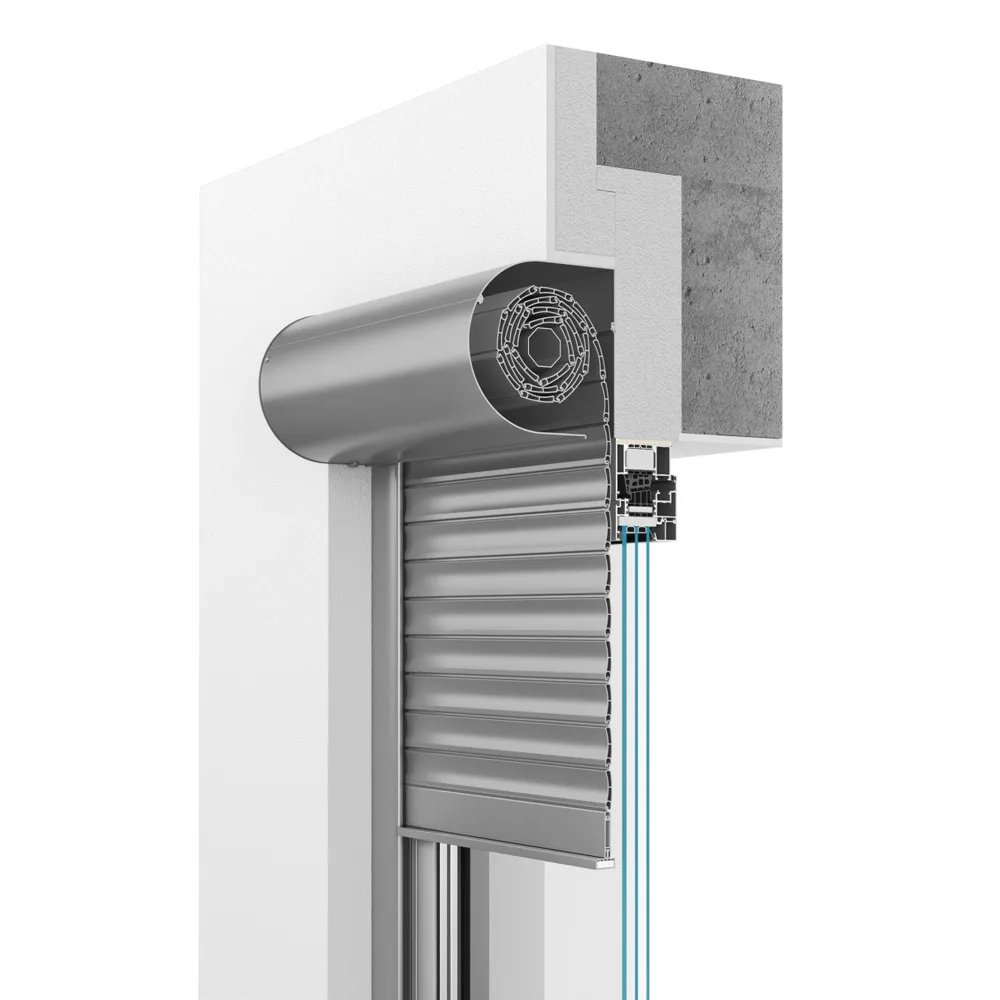
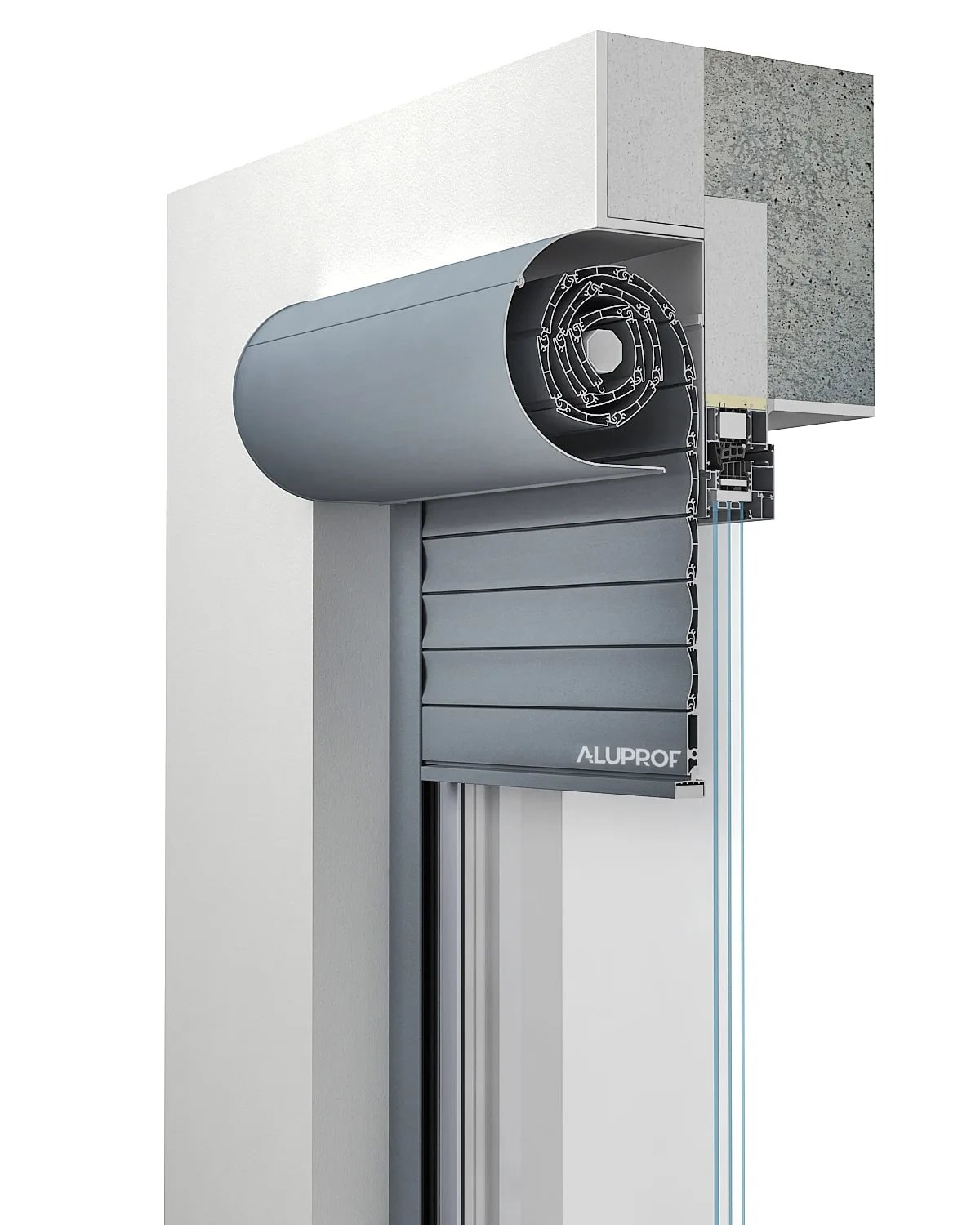
A roller shutter is the only protective element that sits outside and does its work before a burglar even touches the window. An ordinary external shutter has one inherent weakness: a closed curtain can be levered up from below with a jemmy. The Aluprof burglar-resistant series are designed to remove exactly that.
Safety Plus — RC2 for a flat or a house
At the heart of the system is a patented ratchet mechanism in the LDG 41/W bottom bar: the lock boxes are fixed from inside the room, and if anyone tries to lift the curtain from outside, the catch bears against the guide rail. The tested specification comprises the extruded curtain PE 41, reinforced guide rails PPW 66, a bottom bar with the W_LDG 41/W reinforcement and WB pressure blocks. The certificate covers both surface-mounted and built-in installation — so RC2 can be achieved on a new build with the box inside the insulation and on an existing house alike.
Safety Premium — RC3, when your opponent has come prepared
RC3 assumes a burglar with a crowbar and time on his hands. Safety Premium became the first shutter of this class in Poland; the tests were carried out by the German institute IFT Rosenheim to the current edition of EN 1627:2021. Three lines of defence: guide rails with special reinforcement, so the profile can be neither bent out nor pulled from its channel; an extruded aluminium curtain, PE 55, which withstands impact and attempts to punch through; and a latch mechanism at the bottom that resists lifting. The maximum size of a single curtain is 2800 × 4480 mm.
In everyday use both series behave like any other Aluprof shutter: darkness, a quieter street, more warmth in winter, a motor with a radio remote or a smart-home routine that closes the whole house at the touch of a button, and a colour from the palette to match the façade.
Sizes and installation: where the certificate ends
Every class has maximum sizes (see the table above), and they follow directly from what was tested in the laboratory. RC3 cannot be ordered for a 2 × 2.5 m window — not because nobody wants to supply it, but because no such sample was ever tested. The second constraint is installation: the anchors, fixing centres, joint filling and the shutter mounting method (surface-mounted or built-in) are all specified by the manufacturer. Our fitters work to those instructions, and we record the specification on the handover document so you can present it to your insurer.
Which class to choose
- A flat on the third floor or above — RC2 on the balcony door and on any window giving onto an accessible roof or loggia; the remaining windows can stay standard.
- A flat on the first or second floor — RC2 on all windows and doors and, where possible, Safety Plus shutters outside: they take care of privacy at the same time.
- A detached house — RC3 doors, RC2 or RC3 windows on the ground floor, and Safety Premium RC3 shutters outside on the terrace and on windows not visible from the street. This is the combination insurers usually ask for when covering valuable contents.
- Shop, office, warehouse — RC3 on the entrance assembly and ground-floor shopfronts, RC3 shutters or SDZ gates on vehicle entrances; for banks and vaults, RC4 and a bespoke design.
One last point: a class protects you from break-ins, not from oversights. A window left open on vent is an open window whatever its class. That is why we offer automation alongside burglar-resistant constructions: sensors and a routine that closes the shutters itself in the evening or while you are away.
Frequently asked questions
Does an RC class guarantee nobody will break in?
No. The class means the construction withstood a break-in attempt with a defined set of tools for the prescribed time. The point of security is to make a break-in slow and noisy, so the burglar moves on to an easier target.
Can a burglar-resistant shutter be fitted to an ordinary window?
Yes. Safety Plus and Safety Premium are installed on existing PVC, timber and aluminium windows — surface-mounted, or built in when the façade is being refurbished. The class of the shutter does not depend on the class of the window.
How does the price of a burglar-resistant shutter compare with a standard one?
The extra cost is for the reinforced curtain, the guide rails and the lock; the box, the motor and the colours are the same. We work out the exact difference in the security shutter calculator, using the Aluprof price list.
Do insurance companies in Latvia recognise RC classes?
Insurers work to the European standard EN 1627, so a test report together with an installation record stating the specification is normally accepted. Check the terms of your particular policy with your own insurer.