
Why external shading works better than anything indoors
Any indoor blind is fighting heat that has already come through the glass: the sun warms the fabric or the slats, and they in turn warm the room. External blinds stop the sun before the glass, so the heat stays outside. In practice that is a few degrees’ difference in the room in summer and noticeably less work for the air conditioning; for houses with large south- and west-facing glazing it is the only way to keep the living room from turning into a greenhouse without blacking out the windows. The second benefit is privacy and glare control while keeping the view: the slats tilt, so the light is metered rather than shut out.
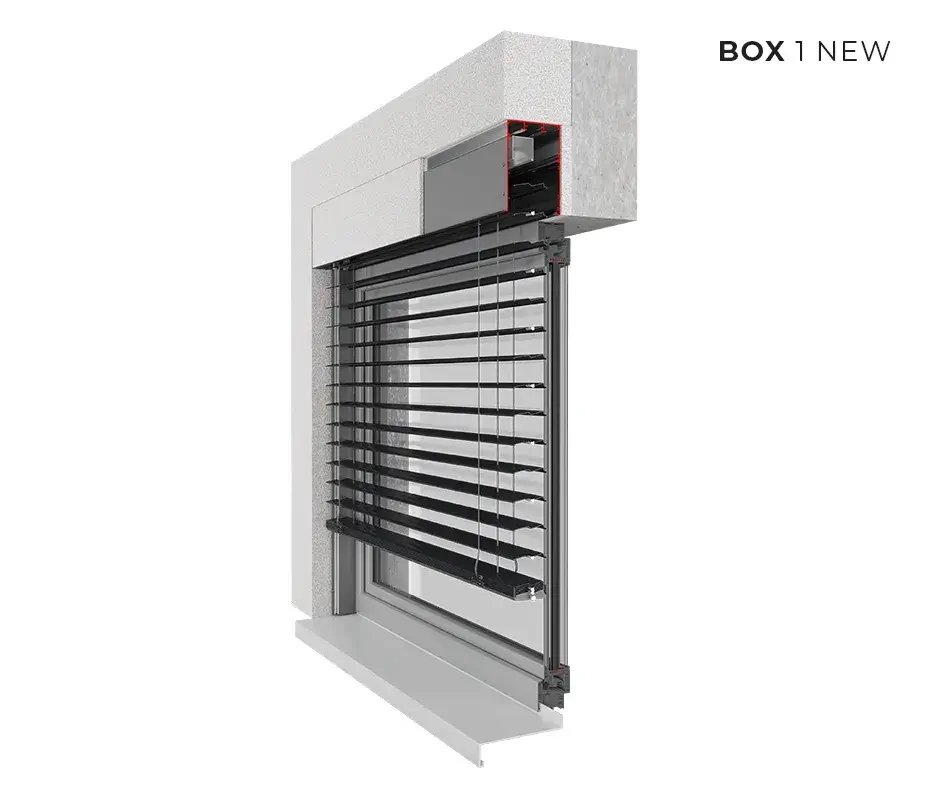
External venetian blinds — also known as raffstores, from the German Raffstore — are aluminium slats 50–90 mm wide on ladder tapes, raised and tilted by an electric drive; the blind runs in aluminium guide rails or on steel cables. Aluprof calls its system SkyFlow, and it comes in twelve configurations.
C and Z slats: what is the difference
- C 80 — an 80 mm slat with a C-shaped section and rolled edges. The classic: 90° tilt (180° optional), soft diffused light, with small gaps left when closed. Cheaper than Z at the same sizes.
- Z 90 — a 90 mm slat with a Z-shaped profile and a rubber seal along the edge. When closed, the slats interlock and form an almost continuous plane: better darkening, less wind noise and a stiffer blind. The choice for bedrooms and anywhere maximum shading matters.
- C 50 L and C 50 Slim — compact 50 mm slats for interior and surface mounting: C 50 L on cables with 180° tilt, C 50 Slim a thinner slat, free-hanging or on cables. For windows up to 3–4 m wide, conservatories and glazed loggias where a large headbox will not fit.
The Z 90 and C 80 slats come in 20 standard colours at no extra cost: RAL 9006, 9007, 7016, 9010, 9016, 7035, 7021, 7024, 9005, 8014, 1015, 1013, 7038, 7039, 7048, 7012, VSR 240, VSR 780, DB 703 and others; C 50 L offers 4 colours and C 50 Slim 8.
Headbox, cassette or open: the 12 Aluprof systems
| System | What it is | Where it goes | Slats |
|---|---|---|---|
| BOX / EDGE 1 · 2 (SkyFlow BOX) | a powder-coated aluminium headbox above the window; the price includes the box, brackets, guide rails or cables and the motor | surface mounting on a finished house, with the box visible as part of the façade | Z 90, C 80 |
| BOX / BASIC 3 · 4 | an unpainted headbox to sit under the insulation layer — only a slot for the blind is visible outside | new build or façade insulation: concealed installation | Z 90, C 80 |
| BOX / COMPACT 1 | a compact headbox of reduced height | shallow recesses, refurbishment | Z 90, C 80 |
| SZF/S CUBE / OVAL | open system: the blind with brackets and motor, while the CUBE (rectangular) or OVAL protective cassette and the guide rails are priced separately | under a canopy, in a recess, on a façade with its own finish | Z 90, C 80 |
| SZF/A | open system with an aluminium cover panel, types 1–4 | a recess in the floor slab or the developer’s own box | Z 90, C 80 |
| SZF/IN C50L · C50 Slim | compact 50 mm blinds on cables or free-hanging | interior and surface mounting, conservatories, loggias | C 50 |
The rule of thumb is simple: if you are building or insulating, BASIC under the render; if the house is finished and you would rather not touch the façade, BOX or COMPACT surface-mounted; if there is a recess or a canopy, the open SZF/S with a cassette; and if you want light shading on a loggia, C 50.
Sizes, motors and the 6/9 Nm torque classes
According to the Aluprof price list the blind width runs from 60 to 500 cm in 20 cm steps, and the height up to 4 m and beyond depending on the system (on BOX the height includes the box, on open systems it is measured along the guide rail). A single blind on 4.5 × 4 m glazing is perfectly realistic; anything wider is divided into sections under common control. Each blind has its own motor: the base price includes the Elero JA Soft with mechanical limit switches, while the options are the Elero JA Comfort with electronic limits and an 868 radio receiver, plus the Somfy J4WT (wired), the J4WT Protect with ice and obstacle detection, and the J4S io Protect with io radio. The torque class follows the area: up to 4 m² — 6 Nm, above that — 9 Nm, and the calculator on the site selects it for you.
Steel cables are cheaper and almost invisible, but the blind moves a little more freely in the wind. Aluminium guide rails hold the slats firmly, block more light at the sides and are essential on tall and exposed façades. On upper floors and open sites we always recommend rails.
Controls: switch, remote, sensors, smart home
- The INIS switch for flush mounting — for wired motors; one button per window or group.
- Somfy io remotes — Situo 1 io for a single blind, Situo 1 Var io with slat tilt adjustment (worth noting: an ordinary remote does not set the tilt), and Situo 5 Var A/M io with 5 channels and automatic operation from a sun sensor.
- TaHoma Switch — control from your smartphone, routines based on time and weather, and integration with Aluprof awnings, roller shutters and pergolas on the same io platform.
- Sensors for sun and wind — the blinds lower themselves and angle the slats to follow the sun, then raise when the wind gets up. On external venetian blinds a wind sensor is not a comfort feature but protection for the blind itself.
Setting the electronic limit switches calls for a special cable — we have one, so you do not need it.
When a screen is the better answer
External fabric screens SkyRoll — the same idea of stopping the sun before the glass, but with a PVC-coated glass-fibre fabric (COPACO, Serge Ferrari) tensioned in zip guides. A screen gives an even, semi-transparent shade with no banding, and it is lighter and cheaper than a venetian blind, covering up to 5 × 5 m (16 m²) in a single blind, with R 120 going up to 7 m wide. But it does not tilt: the light is either there or dimmed across the whole area. Choose venetian blinds when it matters that you can meter the light and see the street through part-open slats; choose a screen when you want shade over a large expanse and a light touch on the façade. The two are often combined: blinds on the living-room windows, screens on the terrace glazing.
Installation: new build and finished house
The best moment for external venetian blinds is at design stage. A BASIC headbox is built into the insulation layer, the guide rails run down the reveals, the cable goes into the wall, and from outside you see nothing but the façade. On a finished house we fit BOX surface-mounted, on brackets through the insulation into the structural wall, with the cable run along the façade in a trunking or through the frame. The key survey points: the depth of the recess for the box, whether there is a structural backing behind the insulation, and the routes for the cable and sensors. The lead time in the price list is 2–3 weeks for open systems and around 4 weeks for BOX.
Price: what goes into it
The figures below come from the Aluprof catalogue and include 21 % VAT. The price of the blind covers the slats, ladder tapes, brackets, guide rails or cables and the base Elero JA Soft motor; on open systems the CUBE/OVAL cassette, cover panels and guide rails are added separately. As a guide, for a 120 × 200 cm window: Z 90 in a BOX headbox comes to around €565, C 80 COMPACT around €520, the open SZF/S in Z 90 around €390 plus cassette and rails, and C 50 Slim around €250. Remotes and sensors are then chosen to suit. A construction colour outside the Aluprof palette costs €300 on an order of 1–4 systems, €400 for 5–9, €500 for 10–20, and nothing from 21 systems upwards. Delivery from the factory is €200 per order, or free if you are willing to wait for a full load (a longer lead time). Installation and electrical work are quoted after the survey; the warranty is 2 years.
Frequently asked questions
How do the Z 90 slats differ from C 80?
Z 90 is a 90 mm Z-shaped profile with a seal: when closed the slats interlock and give almost complete darkness, and they are quieter in the wind. C 80 is the classic 80 mm C slat with 90° tilt (180° optional), soft light and a lower price.
Can external venetian blinds be fitted to a finished house?
Yes: the BOX or COMPACT system is surface-mounted — a powder-coated headbox above the window, guide rails down the reveals, and the cable run along the façade or through the frame. The concealed BASIC headbox that sits under the insulation is fitted while the house is being built or the façade insulated.
What sizes do external venetian blinds come in?
The Aluprof price list gives widths from 60 to 500 cm and heights up to 4 m and beyond depending on the system; the product page states limits of 4.5 × 4 m. Wider glazing is divided into sections under common control.
Does every window need its own motor?
Yes, external venetian blinds are only made with an electric drive — one motor per blind. The base price includes the Elero JA Soft, with the Elero Comfort with radio or the Somfy J4 io available at extra cost. Torque class: up to 4 m² — 6 Nm, above that — 9 Nm.
Which is better — external venetian blinds or an external screen?
Venetian blinds meter the light by tilting the slats and keep the view; a SkyRoll screen gives an even, semi-transparent shade, is lighter and cheaper and covers up to 5 × 5 m, but cannot be adjusted. Living-room windows more often get blinds, terrace glazing gets screens.
How much do external venetian blinds cost?
From the Aluprof catalogue, including 21 % VAT, for a 120 × 200 cm window: Z 90 BOX around €565, C 80 COMPACT around €520, the open SZF/S around €390 plus the cassette, and C 50 Slim around €250; remotes and sensors are extra. Delivery is €200 per order and installation is quoted after the survey.